Nao's analysis results
📖Author: Nao

Table of Contents
CliftonStrengths
With top-ranked strengths largely being strategic, there is a pronounced tendency towards gathering information and analysing its accuracy. This style involves a sense of responsibility in disseminating information, refining ideas into a more effective form while communicating responsibly.
They also choose their words carefully. They enjoy considering solutions when problems arise, making them an information-providing type who can offer solutions when sharing information.
However, their problem-solving is limited to situations they can handle independently, and their collaboration skills are low.
Therefore, it is important to note that they tend to be weak when it comes to consulting others.
Top Strengths
- Ideation
- Strategic Thinking
- Intimacy
- Learner
- Responsibility
- Analytical Thinking
- Restorer
- Prudence
- Individualisation
- Collector
Mid-Level Strengths
- Foundational Thinking
- Command
- Destiny Thinking
- Arranger
- Self-Assurance
- Self-Confidence
- Belief
- Discipline
- Goal Orientation
- Introspection
- Empathy
- Communication
- Growth Promotion
- Activity
Lower Qualities
- Future Orientation
- Adaptability
- Positivity
- Excellence
- Achievement
- Social
- Competitive
- Harmony
- Inclusion
- Fairness
VIA
It is consistent that Prudence also ranks highly in CliftonStrengths.
The high Creativity also makes sense, as it overlaps with the ability to generate ideas and express them.
High Intellectual Flexibility also aligns with high strategic strengths in CliftonStrengths. This likely reflects a preference for developing ideas while considering multiple directions.
Scholarly and Curiosity likely stem from a tendency towards learning motivation and broad interests. Daily information gathering probably influences this too.
Conversely, while Individualisation was high in CliftonStrengths, VIA shows a strong tendency towards Fairness.
This stems from a mindset where, while one wishes to avoid discrimination or prejudice, one also desires to tailor responses to suit each individual.
Though seemingly somewhat contradictory, the fairness here refers strictly to ethical conduct, and Individualisation should probably be considered separately.
Top Qualities
- PRUDENCE Thoughtfulness (4.75)
- CREATIVITY Creativity (4.5)
- JUDGMENT Intellectual Flexibility (4.25)
- LOVE OF LEARNING Love of Learning (4)
- CURIOSITY Curiosity (4)
Mid-Level Qualities
- FAIRNESS Fairness (3.75)
- HONESTY Honesty (3.5)
- SPIRITUALITY (3.5)
- FORGIVENESS (3.5)
- HUMILITY (3.5)
- BRAVERY (3.5)
- PERSPECTIVE (3.5)
- HUMOUR (3.25)
- HOPE (3.25)
- APPRECIATION OF BEAUTY/EXCLUSIVITY (3.25)
- LEADERSHIP (3.25)
- KINDNESS (3)
- LOVE (3)
- GRATITUDE (3)
Lower-tier traits
- SOCIAL INTELLIGENCE (3)
- SELF-REGULATION (3)
- TEAMWORK (3)
- ZEST (3)
- PERSEVERANCE (2.75)
BIG5-BASIC
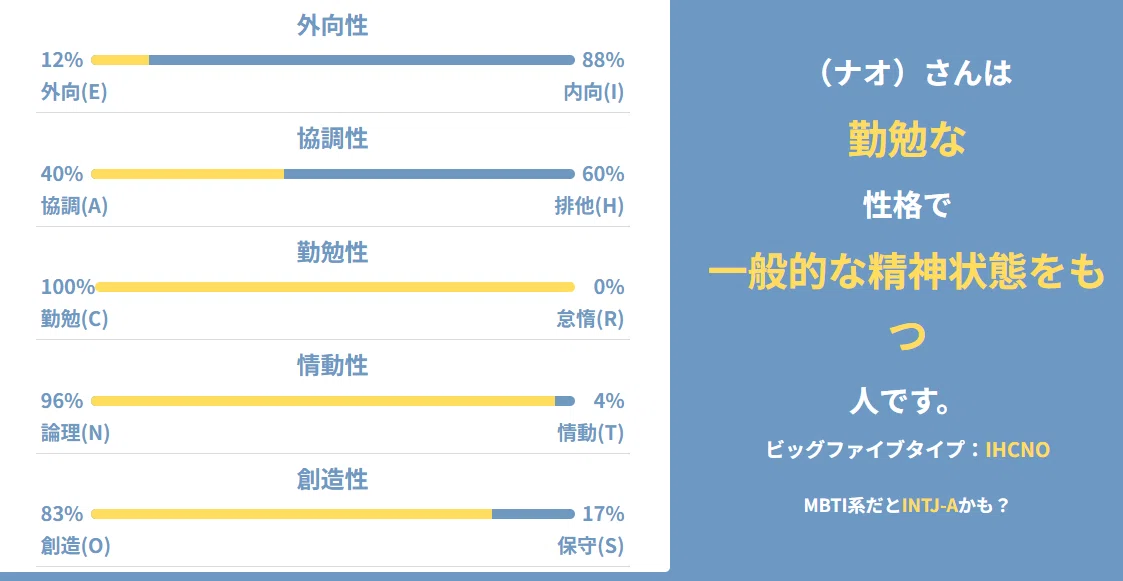
Being introverted can be attributed to a strong tendency towards individualism.
Considering that Intimacy and Individualisation rank highly in Clifton Strengths, and Communication is a lower-ranked trait, it can also be said that she finds interpersonal communication challenging and feels more stable when acting independently.
When viewed through VIA, Contemplation ranking first strongly suggests introversion significantly influences this.
Cooperation is low, though assertiveness and clear expression of personal views are observed when necessary.
Diligence is excessively high, possibly due to overly high self-assessment. This could stem from heightened responsibility manifesting as a tendency to complete tasks thoroughly, keep promises, and adhere to rules.
Emotionality remains stable except during illness, suggesting heightened logic and strategic thinking during normal calm states. These align with Clifton Strengths.
| Item | Value | Rating |
|---|---|---|
| Extroversion | 12% | Low |
| Agreeableness | 40% | Low |
| Conscientiousness | 100% | Very high |
| Logical | 96% | High |
| Creative | 83% | High |
Big Five Personality Assessment
| Item | Score | Rating |
|---|---|---|
| Extraversion | 2 | Low |
| Emotional Stability | 6 | High |
| Openness to Experience | 8 | High |
| Conscientiousness | 8 | High |
| Agreeableness | 0 | Low |
Big Five Assessment: Understanding the Strengths and Weaknesses of Openness, Agreeableness, and Conscientiousness – Low, High | Psychological Tests · Daikomu
Big Five Assessment: Discover the Strengths and Weaknesses of Openness, Agreeableness, and Conscientiousness – Low, High Scores Explained | Psychological Tests - Daicomu
Assessment Results
Extraversion
You tend to have low Extraversion. Individuals with low Extraversion are often perceived as reserved, humble, thoughtful, and possessing a unique worldview. Privately, you likely prefer hobbies enjoyed in small groups over lively gatherings with many people. Professionally, you excel in roles requiring independent thinking and focused concentration. Psychological research suggests introverted individuals often possess strong logical reasoning abilities. This makes careers in research or academia particularly suitable.
Emotional Stability
Emotional stability tends to be high. Individuals with high emotional stability are characterised as being calm, composed, less prone to negativity, and resilient to stress. They can respond calmly even in chaotic situations, meaning they are less likely to make impulsive mistakes.
Openness
Openness tends to be high. Individuals with high openness are characterised by strong curiosity, a preference for new information, an appreciation for the arts, and a spirit of adventure. They tend to be highly motivated to take on challenges and tackle tasks proactively. Their superior imagination and creativity make them well-suited for careers demanding ideas and flexible thinking, such as planning roles, research positions, or fields like design and art.
Conscientiousness
Characterised by a strong sense of responsibility, consistency, keeping promises, and diligently executing plans. Your sincere nature likely earns you the trust of many. At work, you approach tasks earnestly and steadily, demonstrating the tenacity to see through what you undertake to the end. Research by Judge et al. at the University of Iowa found that individuals high in conscientiousness tend to have higher ‘job satisfaction’ and ‘occupational status’. Many also report greater job satisfaction.
Agreeableness
You tend to score low on agreeableness. Those with low agreeableness are characterised by not reading the room, being competitive and challenging, not being swayed by others, and maintaining their own pace. As they are less concerned with others’ reactions or social standing, they can make strong, forthright assertions. At times, these assertions can save the group in a crisis.
16personalities
It may be best to view 16personalities not as an official MBTI diagnostic tool, but rather as a playful personality assessment.
This is because even if such traits exist, whether one remains consistently in the same state can vary depending on the timing of the assessment.
In this sense, the Big Five model tends to be more reliable.
Regarding 16personalities analysis: in a healthy state, the result tends towards an A rating; when affected by mental health issues, it leans closer to a T rating.
Being an Introvert (I) aligns with the Big Five.
Being an Intuitive (N) corresponds to high Creativity in the Big Five.
Being a Thinking (P) type aligns with high Logic in the Big Five.
Being a “Planner” (J) aligns with high conscientiousness in the Big Five.
Being assertive (A) aligns with low agreeableness in the Big Five.
[INTJ Personality Type (Architect) | 16Personalities www.16personalities.com](https://www.16personalities.com/ja/intj% E5%9E%8B%E3%81%AE%E6%80%A7%E6%A0%BC)

| Item | Value |
|---|---|
| Introversion | 96% |
| Intuition | 92% |
| Thinking | 87% |
| Planning | 89% |
| Assertiveness | 79% |
Enneagram
Strong Tendencies
My tendencies seen through Type 5 characteristics: I tend to think deeply about matters, gather information, analyse it, and then act cautiously.
- Analytical
- Strongly inquisitive
- Logical
- Multifaceted perspective
- Argumentative
- Overthinks to the point of paralysis
- Lacks sociability
My tendencies seen through Type 6: Values being earnest and sincere, possesses a strong sense of responsibility. Prioritises teamwork.
- High risk management ability
- Fulfils obligations
- Loyal
- Keeps promises
- Faithful to peers and organisations
- Strong sense of responsibility
- Follows rules
- Meticulous preparation
Weak tendencies
My tendencies as seen through Type 2 characteristics: Ultimate individualism. Values personal space, seeks no reward, but often gives others a cold impression.
- Individualistic, resulting in low cooperation
- Emotionally responsive yet simultaneously tends to avoid people
- Uncomfortable caring for others
- Reluctant to engage in communication beyond the bare minimum
My tendencies seen through Type 4 characteristics: Realistic with high emotionality but low sensitivity.
- Low sensitivity
- Emotionally unresponsive
- Unable to understand one’s own feelings
| Type | Number of checks |
|---|---|
| 1. (The Reformer) | 6 |
| 2. (The Helper) | 1 |
| 3. (The Achiever) | 7 |
| 4. (The Individualist) | 2 |
| 5. (The Investigator) | 9 |
| 6. (The Loyalist) | 8 |
| 7. (Enthusiast) | 3 |
| 8. (Challenger) | 5 |
| 9. (Peacemaker) | 5 |
STRENGTHS PROFILE
Consistent with other analyses.
This likely stems from the strength in analytical ability.
Realised Strengths
Writer
You love writing and are skilled at conveying thoughts and ideas through words.
Innovator
You can approach things with original and novel methods.
Incubator
You love thinking things through deeply to reach the best conclusions.
Planner
You plan everything you do, considering all possibilities.
Explainer
You simplify complex matters, making them comprehensible to others.
Personal Accountability
You take responsibility for your decisions and consistently demonstrate accountability.
Creativity
You harness your imagination to produce original work.
Prevention
You anticipate problems before they arise and implement measures to prevent them.
Improver
You constantly seek better methods and strive for improvement.
Motivation
Strongly self-motivated, rigorously driving oneself forward.
Contrasting Perspectives
Provides others with differing viewpoints in any situation.
Growth
Seeks opportunities for growth and development in everything.
Respect for Individuals
Recognises others as unique beings, noticing subtle differences.
Undeveloped Strengths
Unconditional Acceptance
Prefers to accept others without judgement, just as they are.
Self-Awareness
Understands oneself well and is in touch with one’s emotions.
Centredness
Strives to maintain inner calm in most situations.
Feedback
Provides others with fair and accurate feedback.
Equality
You prefer everyone to be treated equally and pay attention to fairness.
Problem Solver
You enjoy solving problems, particularly challenging ones.
Detail
You tend to notice and enjoy small things others often overlook.
Listener
You focus on others’ words and prefer to listen attentively.
Optimism
You strive to maintain a positive attitude and outlook towards life.
Strategic Awareness
You prefer to pay attention to broader factors and the bigger picture.
Relationship Deepener
You tend to build deep, long-term relationships.
Legacy
You wish to create something sustainable that outlasts you.
Gratitude
You are thankful for the positive aspects of life.
Curiosity
You show interest in many things and tend to seek new information.
Persuasiveness
You enjoy guiding others towards your own ideas.
Supportiveness
You like creating conditions for others to grow.
Self-Respect Promoter
You enjoy helping others believe in themselves.
Learned Behaviours
Trust Builder
You can easily establish trusting relationships with others.
Humour
Can see the amusing side of most things.
Time Optimizer
Makes the most of time, utilising it effectively.
Compliance
Follows processes and executes reliably within rules.
Judgement
Makes sound judgements and reaches correct decisions swiftly.
Adaptability
Responds to changing demands and finds optimal solutions.
Humility
Learning to give credit to others and maintain a modest demeanour.
Service
Seeking ways to support and assist others.
Resilience
Using adversity as a driving force to bounce back and achieve even greater results.
Storyteller
Telling stories and harnessing their power to convey insights.
Work Ethic
You can work diligently and take everything seriously.
Adventure
You can embrace challenges beyond your comfort zone without fear of risk.
Resilience
You possess the ability to overcome difficulties and recover swiftly.
Empathy
You can care for others and provide support to the best of your ability.
Moral Compass
You can act according to what you believe is right.
Pride
You can produce work that meets the highest standards of quality and excellence.
Authenticity
You can remain true to yourself, even when facing pressure.
Change Agent
You can actively advocate for change and engage to make it happen.
Catalyst
You have the ability to motivate and inspire others, making things happen.
Emotional Awareness
You can understand and be mindful of others’ emotions and feelings.
Connector
You can discover and facilitate connections between people.
Weaknesses
Courage
You may find it difficult to overcome fear.
Action
You dislike making immediate decisions and taking action.
Perseverance
You find it challenging to persist and achieve success in difficult situations.
Competitiveness
You dislike competing with others to win.
Mission
You tend not to constantly pursue a sense of purpose.
Self-Trust
You often lack confidence and may doubt your abilities.
Attention
You tend to find it difficult to speak up and gain attention.
Empathy
You tend to find it difficult to understand others’ emotions and connect with them.
Organisation
You tend not to be consistently organised in everything you do.
Avoidant Attachment Style
Strongly influenced by early childhood experiences. Difficulties in interpersonal relationships.
High abandonment anxiety.
This influence is judged to be a significant factor in the foundation for high creativity.
Overall Assessment
| Diagnosis | Primary Strengths | Tendencies | Weaknesses |
|---|---|---|---|
| CliftonStrengths | Strategic Thinking, Ideation, Prudence, Learner, Responsibility | Information gathering, analytical thinking, self-contained | Low collaboration and consultation skills |
| VIA | Thoughtfulness, Creativity, Intellectual Flexibility, Learner, Curiosity | Prudent, Ethics-Oriented, Highly Curious | Low Patience and Social Intelligence |
| Big Five | Creativity, Conscientiousness | Introverted, Deep Thinker, Creative | Low Agreeableness |
| Enneagram | Analytical, Inquisitive, Idealistic, Fairness-oriented | Cautious, Rational, Perfectionist tendencies | Overly assertive |
| Strengths Profile | Writer, Ideation, Planner, Creativity, Analytical | Creative, Responsible, Visionary, Deep-dive thinking | Low initiative, competitiveness, empathy |
| Domain | Strengths | Background | Aspects that struggled to develop |
|---|---|---|---|
| Cognitive | Analysis, Strategy, Conceptualisation, Creativity | Excessive thinking stemming from ‘cannot afford to fail’ and ‘must not make mistakes’ | Jump to execution, integration with emotions |
| Introspection | Prudence, Thoughtfulness, Ethics | Developed in environments where judgment errors or emotional outbursts were dangerous | Impulsive play, self-disclosure, intimacy |
| Motivation | Desire to learn, curiosity, academic drive | Anxiety without knowing the correct answer; knowledge-seeking as safety assurance | Permission to indulge in personal “wastefulness” and experience |
| Interpersonal | Sense of responsibility, fairness | Overreading others’ moods and demands; “must be proper” as default | Assertiveness, ability to rely on others, building relaxed relationships |
| Emotions | Intellectual flexibility, fairness | A reaction to experiences of being harmed/rejected when swept up in emotions | Tolerance for emotional fluctuations, ability to express and share feelings |
Examining why these outcomes emerged
Heightened by the anxiety of ‘not being able to fail’
Not being able to fail is akin to perfectionism. Past influences significantly shape this tendency.
Developed logical thinking to avoid emotional reactions.
Intense loneliness from having no one to rely on fosters strong learning ability
Tendency to fill the loneliness of not being able to rely on others through self-solving via information gathering and learning.
Developed a strong sense of responsibility due to a lack of trust in others.
Creativity developed to escape the harshness of reality
Ideas evolved to devise possibilities for confronting real-world problems.
Self-expression through fear-avoidance defence mechanisms became linked to creativity.
Summary
These issues stem from childhood abuse and bullying, which I believe have transformed into my current strengths.
While they may appear as a negative legacy, there is hope that wounds can be transformed into strength.
However, this should not be interpreted as justifying the abuse or bullying.